Unlock a world of possibilities! Login now and discover the exclusive benefits awaiting you.

- Qlik Community
- :
- Support
- :
- Support
- :
- Knowledge
- :
- Support Articles
- :
- How to configure Qlik Sense to use a dedicated Pos...
- Subscribe to RSS Feed
- Mark as New
- Mark as Read
- Bookmark
- Subscribe
- Printer Friendly Page
- Report Inappropriate Content
How to configure Qlik Sense to use a dedicated PostgreSQL database

 Sebastian_Linse
- Mark as New
- Bookmark
- Subscribe
- Mute
- Subscribe to RSS Feed
- Permalink
- Report Inappropriate Content
How to configure Qlik Sense to use a dedicated PostgreSQL database
Jul 13, 2026 6:53:42 AM
Mar 16, 2021 10:33:39 AM
This article is provided as-is and to be used at own discretion. Depending on tool(s) used, customization(s), and/or other factors ongoing support on the solution below may not be provided by Qlik Support.
The Qlik Sense Repository Database (QSR) can be moved to a dedicated, standalone PostgreSQL instance not hosted on the same machine as other Qlik Sense Services. It is also possible to move an already existing QSR from a local Sense install to a dedicated PostgreSQL database.
Content:
- Set up a PostgreSQL database
- Simplified checklist of steps:
- Moving the Qlik Sense Share Folders as well?
- Backup
- Restore
- Changing the Connection String to QSR and QSMQ Database
- Changing the Connection Stringto SenseServices Databases.
- Changing the Connection String to Licenses Database ( April 2019 and up )
- Remove Database Service dependency and Postgres Server
- Finalize
Set up a PostgreSQL database
Instructions for this might vary slightly. Please refer to the Qlik Online Help for details. We recommend watching this video.
Qlik Sense Enterprise server has a set of five databases. For more details, visit Installing and configuring PostgreSQL on help.qlik.com.
1. The Qlik Sense repository database (QSR):
The QSR is the primary database in your Qlik Sense deployment.
2. The Qlik Sense services database (SenseServices):
The SenseServices database contains schemas for each of the Qlik Sense services and allows growth independently of the Qlik Sense Repository Database, while still sharing the same PostgreSQL instance and login role.
3. The Qlik Sense message queue database (QSMQ):
The QSMQ database provides a light-weight method of passing messages internally between services in Qlik Sense Enterprise. The NOTIFY and LISTEN functionality in PostgreSQL allows services to be notified about new messages that have been written to the messaging table.
4. The Qlik Sense logging database (QLogs): No longer supported after May 2021
The QLogs database centralizes logging by collecting log messages from all Qlik Sense nodes in your deployment and storing them in a PostgreSQL database.
5. The Qlik Sense license service database (Licenses):
The Licenses database is used to sync the assignments between the Qlik license backend and the local installation.
Simplified checklist of steps:
- Download a valid version of PostgreSQL. For Sense June 2017 and up, 9.6.x is required, from November 2019 version 11.5.x as well. From May 2021, version 12.5 can be used. Review the system requirements of your version before proceeding.
- Follow the instructions in Installing and configuring PostgreSQL
Moving the Qlik Sense Share Folders as well?
Follow How to change the shared path in Qlik Sense
Backup
Depending on the version, you need to back up different databases. On the current Qlik Sense central node hosting the Qlik Sense Repository Database service, follow the backup instructions to obtain a database copy of each Qlik Sense Database Present.
Restore
On the dedicated remote PostgreSQL host, perform a restore of the backed-up databases of previous point.
Changing the Connection String to QSR and QSMQ Database
- On the Qlik Sense central node, all services but the Qlik Sense Repository Service are shut down.
- Open QlikSenseUtil. By default, this will be installed in: C:\Program Files\Qlik\Sense\Repository\Util\QlikSenseUtil\QlikSenseUtil.exe
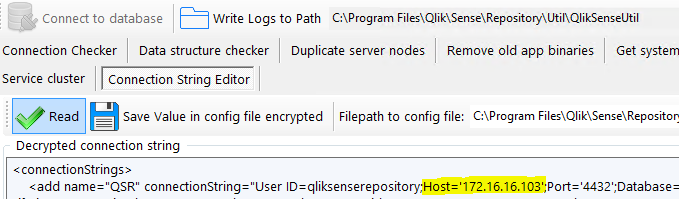
- Open the Connection String Editor and Read the current configuration, decrypting the current data.
- Replace all mentions of the current database hostname. In our example, the new database resides on 172.16.16.103. Instead of an IP you can also use the FQDN of the db server.
- You need to repeat this step for the sections <add name="QSMQ" and <add name="postgres"
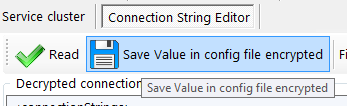
- Hit Save Value in config file encrypted, committing any changes.
Changing the Connection String to SenseServices Databases.
Execute steps in Moved Postgress database to new host, but some qliksense is still accessing the SenseServices old da...; check if different versions of the article are present for different Qlik Sense version.
Changing the Connection String to Licenses Database ( April 2019 and up )
Starting from April 2019, the new License Service implementation is using this database.
- Open an elevated PowerShell and change directory to C:\Program Files\Qlik\Sense\Licenses
- Run the script .\Configure-Service.ps1 and provide:
- new Hostname or IP
- database port default is 4432
- database user qliksenserepository
- databasepassword is the qliksenserepository password used during configuration of the new database.
- example:
- cd 'C:\Program Files\Qlik\Sense\Licenses'
- .\Configure-Service.ps1 172.16.16.102 4432 qliksenserepository Password123!
It will look like this:
Copyright (C) 2014 Microsoft Corporation. All rights reserved.
PS C:\Windows\system32> cd \
PS C:\> cd 'C:\Program Files\Qlik\Sense\Licenses'
PS C:\Program Files\Qlik\Sense\Licenses> .\Configure-Service.ps1 172.16.16.102 4432 qliksenserepository Password123!
Licenses configuration started.
WARNING: Skipping the database initialization. No superuser or password specified.
Reading the settings file.
Saving the modified settings.
Licenses configuration successful.
PS C:\Program Files\Qlik\Sense\Licenses>
repeat this for:
C:\Program Files\Qlik\Sense\NotifierService\install\Configure-Service.ps1
C:\Program Files\Qlik\Sense\AppDistributionService\Configure-Service.ps1
C:\Program Files\Qlik\Sense\HybridDeploymentService\Configure-Service.ps1
C:\Program Files\Qlik\Sense\MobilityRegistrarService\install\Configure-Service.ps1
C:\Program Files\Qlik\Sense\PrecedentsService\install\Configure-Service.ps1
C:\Program Files\Qlik\Sense\NLAppSearch\install\Configure-Service.ps1
there might come new services or disappear with new releases, please check in the C:\Program Files\Qlik\Sense\ folder for "Configure-Service.ps1" to find additional one in your version of Qlik Sense.
Note: If you have installed Qlik Sense in a different directory the Configure-Service.ps1 would have to be updated as in this example:
File: Configure-Service.ps1 Folders: Various (9 microservices)
Before:
11 | [string] $senseInstallPath
"$env:ProgramFiles\Qlik Sense",
After:
11
[string] $senseInstallPath = "D:\Qlik",
Remove Database Service dependency and Postgres Server
After successfully verifying your new setup, remove the Qlik Sense Repository service dependencies and the old Postgres database. This is done to avoid issues with future upgrades of the environment.
- In an elevated command prompt, execute the following on prompt:
c:\sc config "QlikSenseRepositoryService" depend= ""
c:\sc config "QlikLoggingService" depend= ""
This will return:
[SC] ChangeServiceConfig SUCCESS - Restart the Qlik Sense Repository Service.
Check that Qlik Sense Repository Database doesn't start (confirms [SC] ChangeServiceConfig SUCCESS ). - Remove the (local) Qlik Sense Repository Database
Find the most recent PostgreSQL.msi in C:\ProgramData\Package Cache\ and remove it. This removes the service, but no old local database data. This is needed to prevent issues on future upgrades of the environment.
You can find the precise folder with this command, depending on the PostgreSQL version you used to install the initial release.
9.6:
c:\cd ProgramData\Package Cache
c:\ProgramData\Package Cache\dir /s PostgreSQL.msi
The folder containing PostgreSQL.msi will be revealed. Right-click on the PostgreSQL.msi file and select Uninstall from the menu.
12.5:
c:\cd ProgramData\Package Cache
c:\ProgramData\Package Cache\dir /s PostgreSQL125.msi
The folder containing PostgreSQL.msi will be revealed. Right-click on the PostgreSQL.msi file and select Uninstall from the menu.
Finalize
- Restart the Qlik Sense Repository Service and verify that the Qlik Sense Repository Database Service doesn't exist when following the previous steps.
- Start all remaining Sense Services
- Progress on the startup sequence (including the connection to the new database) can be tracked in the _System_Repository log files located in C:\ProgramData\Qlik\Sense\Log\Repository\Trace
- Verify functionality.
-
In a multi-node scenario, you need to repeat steps "Changing the Connection Strings to Databases" on all Rim nodes (QlikSenseUtil for Repository.exe.config and Configure-Service.ps1 for the micro services), and if required, configure "Update the Qlik Logging Service Connection String" (note that is EOL with Qlik Sense Enterprise on Windows February 2022).
Environment

 galinych
- Mark as Read
- Mark as New
- Bookmark
- Permalink
- Report Inappropriate Content
Hello.
We have a database cluster of two servers hostdb1 and hostdb2. Is it possible to configure QS to use two servers simultaneously? If hostdb1 is not available, then QS switches to hostdb2.
Sebastian_Linse- Mark as Read
- Mark as New
- Bookmark
- Permalink
- Report Inappropriate Content
hello,
no that is not implemented out of the box. You will have to adjust the connection string from the Repository to talk to database2.
Here are some ways to use replication
regards
Sebastian

 AkashPohare_HB
- Mark as Read
- Mark as New
- Bookmark
- Permalink
- Report Inappropriate Content
Hello @Sebastian_Linser , @Sonja_Bauernfeind ,
Currently, we are using dedicated postgres DB running on windows servers with default port and superuser. However, due to new controls, we have to migrate the postgres DB from windows to Linux server with custom port and may be different version. This article Configure Postgres , suggests on how to migrate to dedicated postgres DB on windows server with default port and superuser, however does not include information about custom port and different version of DB on Linux servers.
Kindly help to understand on what steps and changes are required to migrate to Linux server with custom port, different DB version?
Thanks.
 Sonja_Bauernfei
- Mark as Read
- Mark as New
- Bookmark
- Permalink
- Report Inappropriate Content
Hello @AkashPohare_HB
If Qlik Sense uses a PostgreSQL database on a dedicated infrastructure, then it can use supported versions of PostgreSQL. To know which versions of PostgreSQL are supported in Qlik Sense, see: System requirements for Qlik Sense Enterprise.
You can run the instance of PostgreSQL on platforms including Windows, Linux or cloud hosted services, such as Amazon RDS. However, Qlik will only offer configuration support when PostgreSQL is running on Windows. If you use Linux or Amazon RDS, it is your own responsibility to install and configure a running instance of PostgreSQL for Qlik Sense to use.
As for your port question: You choose the port you wish to use when you set up Qlik Sense. What port you set on PostgreSQL is up to you in that case.
All the best,
Sonja
AkashPohare_HB
- Mark as Read
- Mark as New
- Bookmark
- Permalink
- Report Inappropriate Content
Hi @Sonja_Bauernfeind ,
I am aware that you don't support postgres on Linux, however my query is around configuration.
This article demonstrates the steps to migrate the repository database to standalone postgres on windows with default port and superuser, however I am looking what are steps to follow if a custom port is used on the postgres server. Any additional steps needs to be followed or we have to change the port in the util.exe file and for microservices need to run ".\Configure-Service.ps1 pghostname customport qliksenserepository qlik" ?
Thanks.
Sonja_Bauernfei- Mark as Read
- Mark as New
- Bookmark
- Permalink
- Report Inappropriate Content
Hello @AkashPohare_HB
The configuration on the Qlik Sense side remains the same, regardless of the platform, meaning the steps remain the same overall. As for changing the port afterwards, yes, that is correct! You already have the right way forward here.
If you need more detailed help, I suggest posting follow-up questions on the Management & Governance forum for Qlik Sense.
All the best,
Sonja
- « Previous
- Next »


