Unlock a world of possibilities! Login now and discover the exclusive benefits awaiting you.

- Qlik Community
- :
- All Forums
- :
- QlikView
- :
- Qlikview Set analsis
- Subscribe to RSS Feed
- Mark Topic as New
- Mark Topic as Read
- Float this Topic for Current User
- Bookmark
- Subscribe
- Mute
- Printer Friendly Page

- Mark as New
- Bookmark
- Subscribe
- Mute
- Subscribe to RSS Feed
- Permalink
- Report Inappropriate Content
Qlikview Set analsis
my data is
| creation dateMonth | completion dateMonth | totalsale |
| Jan-11 | Mar-11 | 10 |
| Feb-11 | Mar-11 | 20 |
| Mar-11 | Apr-11 | 30 |
| Apr-11 | Apr-11 | 40 |
required out is
monthyear
| creation date | sum(totalsale) | sumtotalcompletion | |
| 100 | 100 | ||
| Jan-11 | 10 | 0 | |
| Feb-11 | 20 | 0 | |
| Mar-11 | 30 | 30 | |
| Apr-11 | 40 | 70 | |
issue: unable to calculate 'sumtotalcompletion' column.
Itried=
Sum(Total {<[Completion dateMont]={'$(=MonthNAme(Max([CATS Creation dateMonth]))'}>}[totalsale])
but not working
PFA sample.
Thanks
Raj

 sinanozdemir
- Mark as New
- Bookmark
- Subscribe
- Mute
- Subscribe to RSS Feed
- Permalink
- Report Inappropriate Content
Hi Raj,
It is not the most elegant way of doing this, but I played with the data model first:
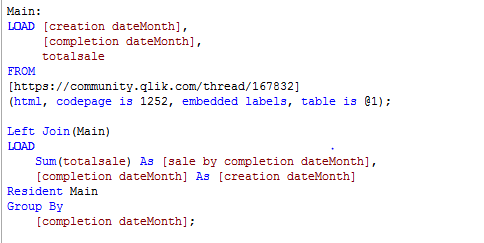
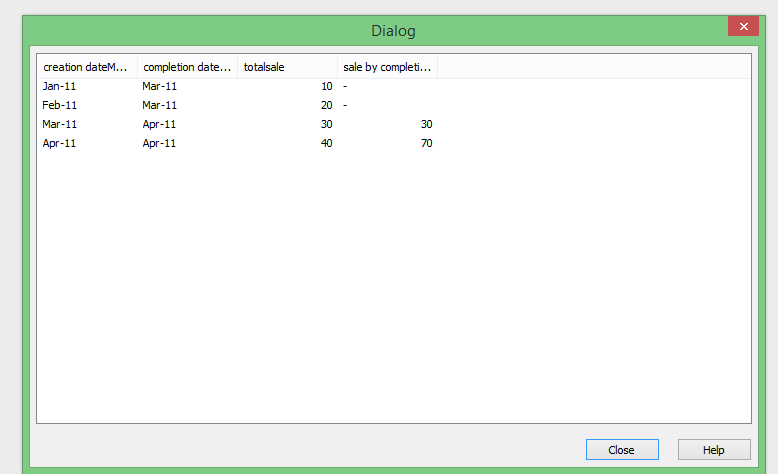
As you can see, I summed totalsale by completion dateMonth and re-named it creation dateMonth. As a result of this, the data model had the below structure:
And in the front end, I simply utilized sum function:
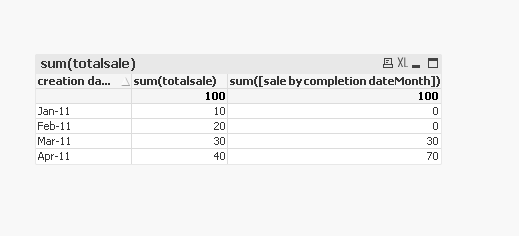
Hope this helps.
Thanks
- Mark as New
- Bookmark
- Subscribe
- Mute
- Subscribe to RSS Feed
- Permalink
- Report Inappropriate Content
Ya I know above process but my real table is quite big(millions of records), so performing join will affect the load performance. So I am looking a solution by set analysis.