Unlock a world of possibilities! Login now and discover the exclusive benefits awaiting you.

- Qlik Community
- :
- All Forums
- :
- QlikView
- :
- Re: Age Function
- Subscribe to RSS Feed
- Mark Topic as New
- Mark Topic as Read
- Float this Topic for Current User
- Bookmark
- Subscribe
- Mute
- Printer Friendly Page

- Mark as New
- Bookmark
- Subscribe
- Mute
- Subscribe to RSS Feed
- Permalink
- Report Inappropriate Content
Age Function
Hey There,
i use on my data model at the age function & Interval for some reason i get not the right age, any idea what im doing wrong ?
On sql servel i use this "DATEDIFF(Year,E.BirthDate,GetDate()) EmployeeAge" but i know datediff does not work on qv so i try this other method.
Regards
David
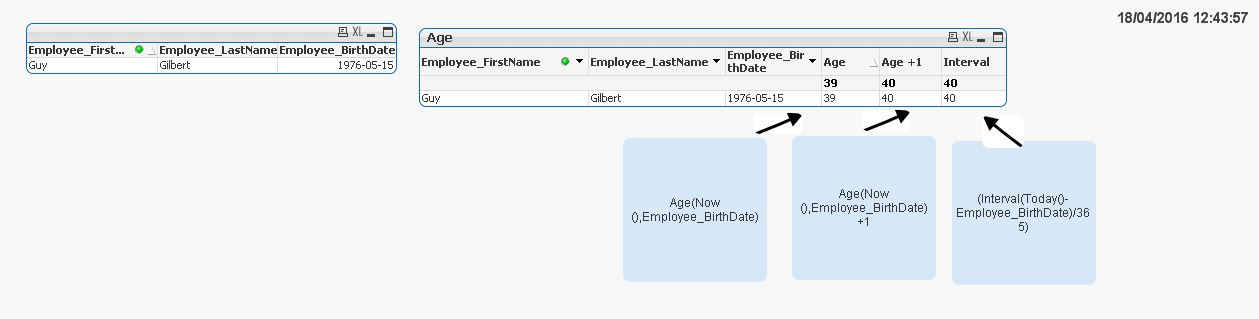
- « Previous Replies
-
- 1
- 2
- Next Replies »

 swuehl
- Mark as New
- Bookmark
- Subscribe
- Mute
- Subscribe to RSS Feed
- Permalink
- Report Inappropriate Content
Are you talking about applying Age() to dates before year 1582, i.e. start of the gregorian calendar?
I believe QV will keep to the gregorian calendar and apply it's rules to the time before it was introduced (proleptic calendar). But I haven't tested it (haven't worked with databases containing these dates so far).
If your question is a concern about leap year handling, what concerns do you have exactely?

 lawrenceiow
- Mark as New
- Bookmark
- Subscribe
- Mute
- Subscribe to RSS Feed
- Permalink
- Report Inappropriate Content
swuehl, my issue is simply to do with calculating a persons age. From my understanding (which may not be that great) dividing the days by 365.25 would be good enough for the living as it gains 1 day in 128 years. So in calculating the age which include the deceased I've since used 365.2425
Instead of using formulae such as
floor((eventDate-DateOfBirth)/365.2425) as PersonAge
I thought it might be neater to use
age(eventDate, DateOfBirth) as PersonAge
So, I just wanted to check that it would be safe to use this function.
Thanks for your help.
swuehl
- Mark as New
- Bookmark
- Subscribe
- Mute
- Subscribe to RSS Feed
- Permalink
- Report Inappropriate Content
I think the Age() function is more accurate in returning an integer number that is commonly regarded as age, i.e. increased by 1 each year whenever the day and month of the DateOfBirth value is reached.
- « Previous Replies
-
- 1
- 2
- Next Replies »