Unlock a world of possibilities! Login now and discover the exclusive benefits awaiting you.

- Qlik Community
- :
- All Forums
- :
- QlikView
- :
- Re: Section access using the users in active direc...
- Subscribe to RSS Feed
- Mark Topic as New
- Mark Topic as Read
- Float this Topic for Current User
- Bookmark
- Subscribe
- Mute
- Printer Friendly Page

- Mark as New
- Bookmark
- Subscribe
- Mute
- Subscribe to RSS Feed
- Permalink
- Report Inappropriate Content
Section access using the users in active directory
Hi
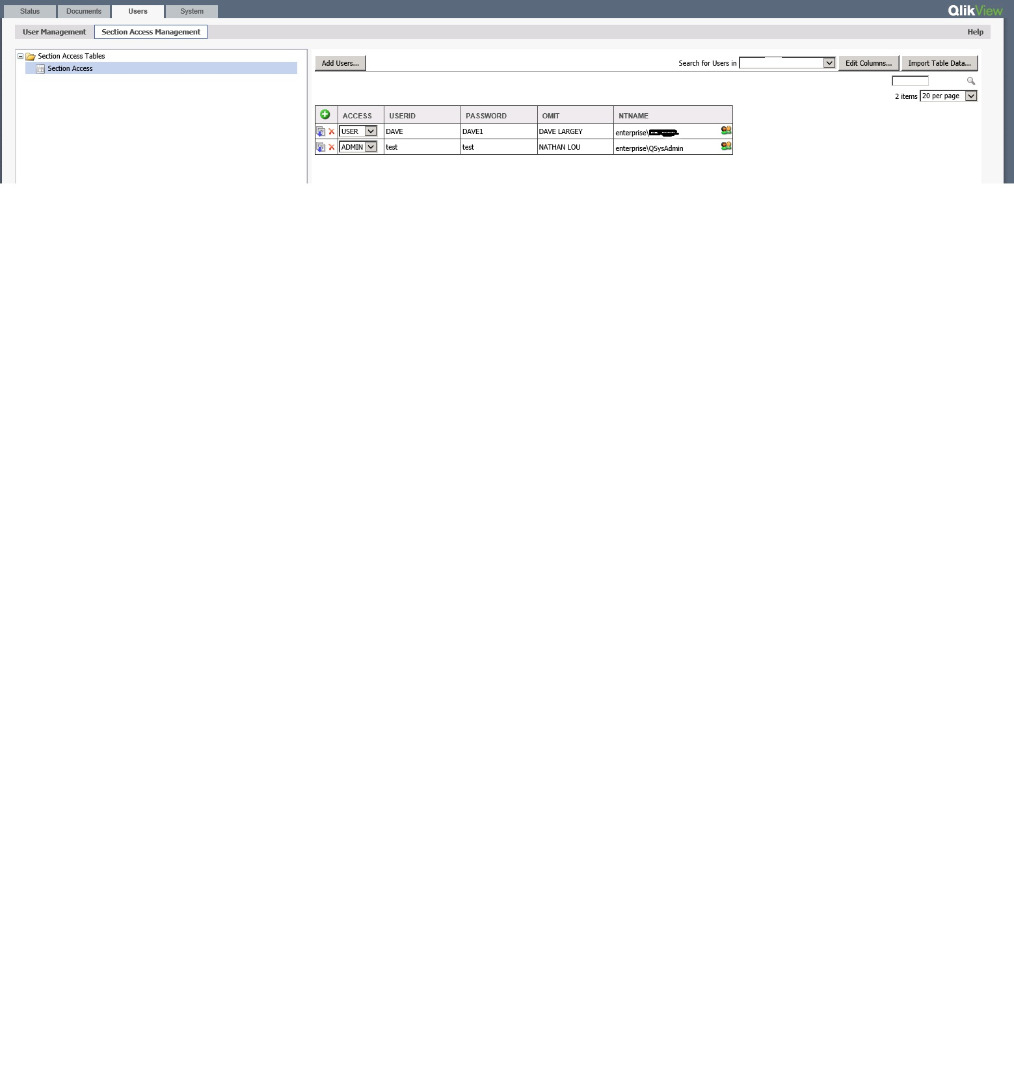
i'm having a situation where in i have some users configured for logon in active directory, i want to use that for data reduction in my qlikview file. i have created a section access information in user section of server.
the question is how do i configure it to use logon crdentials, or do i have to enter them manually as in the below figure.
Accepted Solutions

 Peter_Cammaert
- Mark as New
- Bookmark
- Subscribe
- Mute
- Subscribe to RSS Feed
- Permalink
- Report Inappropriate Content
If you just want to use Windows SSO as authentication method, omit the USERID and PASSWORD columns. If you want to mix USERID/PASSWORD logins with SSO access, put an asterisk in the USERID & PASSWORD fields for every user that has to be able to log in via SSO. Those users will need an NTNAME entry for sure.
BTW don't forget to create a Section Access; area in your load script that performs a LOAD of the data from your specific QMC table. There is no automatically applicable security with data reduction in QlikView.
Best,
Peter
Peter_Cammaert
- Mark as New
- Bookmark
- Subscribe
- Mute
- Subscribe to RSS Feed
- Permalink
- Report Inappropriate Content
If you just want to use Windows SSO as authentication method, omit the USERID and PASSWORD columns. If you want to mix USERID/PASSWORD logins with SSO access, put an asterisk in the USERID & PASSWORD fields for every user that has to be able to log in via SSO. Those users will need an NTNAME entry for sure.
BTW don't forget to create a Section Access; area in your load script that performs a LOAD of the data from your specific QMC table. There is no automatically applicable security with data reduction in QlikView.
Best,
Peter
- Mark as New
- Bookmark
- Subscribe
- Mute
- Subscribe to RSS Feed
- Permalink
- Report Inappropriate Content
Thanks Peter 
I really appreciate that
- Mark as New
- Bookmark
- Subscribe
- Mute
- Subscribe to RSS Feed
- Permalink
- Report Inappropriate Content
Hello Peter,
Is it possible for you to provide a sample file that has the solution? Have been struggling with this for a while.