Unlock a world of possibilities! Login now and discover the exclusive benefits awaiting you.

- Qlik Community
- :
- Forums
- :
- Analytics & AI
- :
- Products & Topics
- :
- Visualization and Usability
- :
- Re: Sum selected values using concat and if
- Subscribe to RSS Feed
- Mark Topic as New
- Mark Topic as Read
- Float this Topic for Current User
- Bookmark
- Subscribe
- Mute
- Printer Friendly Page

- Mark as New
- Bookmark
- Subscribe
- Mute
- Subscribe to RSS Feed
- Permalink
- Report Inappropriate Content
Sum selected values using concat and if
| ID_ONE | ID_TWO | ID_THREE | IA | |
|---|---|---|---|---|
1 | 10 | 100 | 1000 | |
| 2 | 11 | 101 | 2000 | |
| 2 | 11 | 102 | 3000 | |
| 2 | 12 | 103 | 4000 | |
| 3 | 13 | 104 | 5000 | |
| 4 | 14 | 105 | 6000 | |
| 4 | 15 | 106 | 7000 |
Hello Dear Community,
I am looking for a way to sum the complete IA of ID_One if ID_ONE is present in one row selected by if conditions.
So first I want to selct the ID_ONE´s, which meet the If-conditions.
Then I want to sum the IA in all rows, in which ID_ONE is present.
Example:
Distinct If ((ID_TWO=11 or ID_TWO=12 or ID_TWO=13 or ID_TWO=14)
and (ID_THREE = 101 or ID_THREE = 103 or ID_THREE = 105) ,ID_ONE)
This way I would get the ID_ONE´s 2 and 4.
And then I want to sum the belonging IA. So the result should be ((2000+3000+4000)+(6000+7000)) = 22.000.
To achieve this I thought of using Concat-function in combination with SubstringCount.
I have provided an Example App below. The data is a bit different. I tried it like this:
IF(SubstringCount(
Concat( Distinct ID_ONE,';'),
Concat(Distinct If([K_ONE]>2000 AND ([K_TWO]<2000 OR [K_Three]<>6) ,ID_ONE),';')
)=0,
Sum(IA))
I would be grateful if someone could help me with that.
Btw: I am using qlik Sense and the Limits for the if comparisions (11,12,13,14,2000, 6...) are actually Variables in my real Applikation.
Best regards
Accepted Solutions
- Mark as New
- Bookmark
- Subscribe
- Mute
- Subscribe to RSS Feed
- Permalink
- Report Inappropriate Content
Ok. The formula I found (actually a colleague, who works on the same Project  ) works perfectly fine and I think it is pretty amazing:
Sum(
If(
Substringcount(
Concat(ALL Distinct If( (condition1) AND (condition2 OR condition3),ID_ONE),';'),Text(ID_ONE)
) >0,
IA)
)
With the Concat-function the set of ID_ONE´s, which meet the conditions, is made explicit in a String. In the next step this String is used via SubstringCount to select the IA I want to sum.
I think this method is a good alternative to Set Analysis.
Because in my opinion if-conditions are a lot easier to understand and to write than set Analysis expressions and you can easily make the set you are using visable.
Nevertheless I would guess the Performance of Set Analysis is better.
- Mark as New
- Bookmark
- Subscribe
- Mute
- Subscribe to RSS Feed
- Permalink
- Report Inappropriate Content
Hi
Why don;t you, go by like this ?
sum( { $<ID_ONE={"=COUNT(ID_ONE)>1"}>} IA)
your query :
This way I would get the ID_ONE´s 2 and 4.
And then I want to sum the belonging IA. So the result should be ((2000+3000+4000)+(6000+7000)) = 22.000.
- Mark as New
- Bookmark
- Subscribe
- Mute
- Subscribe to RSS Feed
- Permalink
- Report Inappropriate Content
Sure for this Little example that would work, but in the real App I have a lot more different fields and about 20 conditions. Just saying sum where Count(ID_ONE)>1 would not work.

 cesaraccardi
- Mark as New
- Bookmark
- Subscribe
- Mute
- Subscribe to RSS Feed
- Permalink
- Report Inappropriate Content
Hi,
You could use set analysis for that, here is an example:
sum({$<ID_TWO={11,12,13,14}>*$<ID_THREE={101,103,105}>} total<ID_ONE> IA)
The expression above calculates the sum of IA aggregated by ID_ONE for the values where there is an intersection ( * ) between the first set $<ID_TWO={11,12,13,14}> (same as your logic: ID_TWO=11 or ID_TWO=12 or ID_TWO=13 or ID_TWO=14) and the second set $<ID_THREE={101,103,105}> (same as your logic: ID_THREE = 101 or ID_THREE = 103 or ID_THREE = 105).
Let me know if that works.
Kind Regards,
Cesar
- Mark as New
- Bookmark
- Subscribe
- Mute
- Subscribe to RSS Feed
- Permalink
- Report Inappropriate Content
I probably just found the solution. I am going to post it, if I can confirm it.

 sunny_talwar
- Mark as New
- Bookmark
- Subscribe
- Mute
- Subscribe to RSS Feed
- Permalink
- Report Inappropriate Content
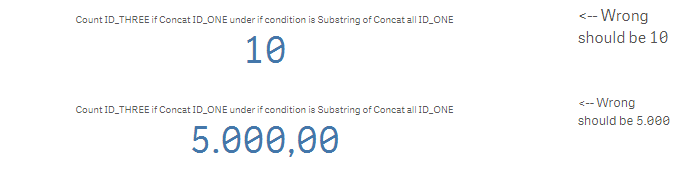
Try this for count
=Count({<ID_ONE = P({<ID_TWO = {11, 12, 13, 14}>})+P({<ID_THREE = {101, 103, 105}>})>}ID_ONE)
and this for Sum
=Sum({<ID_ONE = P({<ID_TWO = {11, 12, 13, 14}>})+P({<ID_THREE = {101, 103, 105}>})>}IA)
- Mark as New
- Bookmark
- Subscribe
- Mute
- Subscribe to RSS Feed
- Permalink
- Report Inappropriate Content
Ok. The formula I found (actually a colleague, who works on the same Project ) works perfectly fine and I think it is pretty amazing:
Sum(
If(
Substringcount(
Concat(ALL Distinct If( (condition1) AND (condition2 OR condition3),ID_ONE),';'),Text(ID_ONE)
) >0,
IA)
)
With the Concat-function the set of ID_ONE´s, which meet the conditions, is made explicit in a String. In the next step this String is used via SubstringCount to select the IA I want to sum.
I think this method is a good alternative to Set Analysis.
Because in my opinion if-conditions are a lot easier to understand and to write than set Analysis expressions and you can easily make the set you are using visable.
Nevertheless I would guess the Performance of Set Analysis is better.