Unlock a world of possibilities! Login now and discover the exclusive benefits awaiting you.

- Qlik Community
- :
- Forums
- :
- Data Integration
- :
- Products & Topics
- :
- Administering and Monitoring
- :
- Re: Get endpoint details with QEM API
- Subscribe to RSS Feed
- Mark Topic as New
- Mark Topic as Read
- Float this Topic for Current User
- Bookmark
- Subscribe
- Mute
- Printer Friendly Page

 Airbus
- Mark as New
- Bookmark
- Subscribe
- Mute
- Subscribe to RSS Feed
- Permalink
- Report Inappropriate Content
Get endpoint details with QEM API
Hi Team,
We are trying to create a script that can return the connection information to a DB (host, database name...) just with the name of the task that has an endpoint connected to this DB.
Do you know if there is a function in the QEM API that could return the details of the information of an endpoint?
If not, the only thing I can think of is exporting the json file and reading the "databases" block.
Thank you in advance for the help,
Best regards,
Accepted Solutions

 Heinvandenheuve
- Mark as New
- Bookmark
- Subscribe
- Mute
- Subscribe to RSS Feed
- Permalink
- Report Inappropriate Content
GetEndpointList does not provide enough detail to satisfy the described request.
Just like 'GetTaskList' has a companion 'GetTaskDetails' it would be nice if there was a GetEndpointDetails but unfortunately there is currently no exposed API for the latter. Feature request?
REPCTL does not provide it either. I think the only useful place an endpoint name can be used is repctl getprovidersyntax.
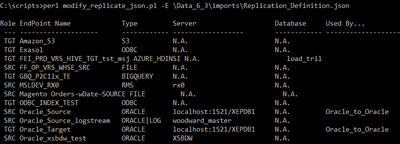
Personally I have always used a task or full export json to list out endpoint characteristics and usages.
I have attached a Perl and a PowerShell script example on how to do this. Oops, I now see that the Powershell version does not list the servername. Oh well, left as an exercise for the reader. From your description I suspect you already are well aware of how to parse for the databases section anyway.
Hein.
Sample from my sandbox :

 sureshkumar
- Mark as New
- Bookmark
- Subscribe
- Mute
- Subscribe to RSS Feed
- Permalink
- Report Inappropriate Content
Hello @Airbus
Kindly check if this API meet your requirements
GetEndpointList
GetEndpointList | Qlik Enterprise Manager Help
Regards,
Suresh
Heinvandenheuve- Mark as New
- Bookmark
- Subscribe
- Mute
- Subscribe to RSS Feed
- Permalink
- Report Inappropriate Content
GetEndpointList does not provide enough detail to satisfy the described request.
Just like 'GetTaskList' has a companion 'GetTaskDetails' it would be nice if there was a GetEndpointDetails but unfortunately there is currently no exposed API for the latter. Feature request?
REPCTL does not provide it either. I think the only useful place an endpoint name can be used is repctl getprovidersyntax.
Personally I have always used a task or full export json to list out endpoint characteristics and usages.
I have attached a Perl and a PowerShell script example on how to do this. Oops, I now see that the Powershell version does not list the servername. Oh well, left as an exercise for the reader. From your description I suspect you already are well aware of how to parse for the databases section anyway.
Hein.
Sample from my sandbox :

 feal
feal
- Mark as New
- Bookmark
- Subscribe
- Mute
- Subscribe to RSS Feed
- Permalink
- Report Inappropriate Content
Hi all
I have a similar issue : it would be nice if there may be a REST API method that exposes main settings on DBMS other than DBMS type and Source/target as GetEndpointList | Qlik Enterprise Manager Help currently does , for example server name, db name in a JSON output as they are exposed in Endpoint Management in Qlik EM interface.
This request is mainly due to current usage of Qlik that is a communication method from different kind of DBMS via CDC event propagation: in a Enterprise scenario, every DBMS has its standard naming convention (and normally there may be multiple DBMS technology and also multiple instances of the same kind) and compressing all useful info in the 32 char long Endpoint name is challenging.
So if there may be many Endpoints, it could be difficult to isolate only impacted objects (endpoints and tasks) for a specific activity on a sever or on a specific Db (for example a planned downtime for a server maintenance) .
If a REST API method extension of a Ad-hoc method is not feasible, if could be useful a PostGres Analytics Endpoint details table that gather these info at a regular times : so a customer can gather easly all info to build a specific report.
Thanks for your consideration
regards
Alessandro
