Unlock a world of possibilities! Login now and discover the exclusive benefits awaiting you.

- Qlik Community
- :
- Forums
- :
- Analytics & AI
- :
- Products & Topics
- :
- App Development
- :
- Re: The Average Function (Chart) result differs fr...
- Subscribe to RSS Feed
- Mark Topic as New
- Mark Topic as Read
- Float this Topic for Current User
- Bookmark
- Subscribe
- Mute
- Printer Friendly Page

 fginfrida
- Mark as New
- Bookmark
- Subscribe
- Mute
- Subscribe to RSS Feed
- Permalink
- Report Inappropriate Content
The Average Function (Chart) result differs from the average (total) on a straight table
I have a data set that shows, by assignee, the date that a service request was placed in a work queue. The table shows all the items in the queue, selectable by assignee. I've configured the table to return average number of backlog days:
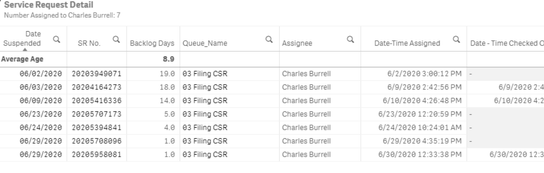
Where the column Backlog Days is forced to be a measure by setting equal to Avg(Backlog_Day_Number). The query that generates a data set for this application returns a value for backlog days which is calculated excluding all non-working days.
The value of 8.9 for the particular assignee is correct - a total of 62 backlog days for 7 service requests. Well and good.
However, when I try to compute the backlog elsewhere in the application, either with the formula
Aggr(Avg(Backlog_Day_Number),Assignee)
Or with a simple
Avg(Backlog_Day_Number) with a selection of "Charles Burrell"
the application returns 11.17.
Clearly I'm failing to understand something about the Avg. Function (and why it differs from selecting a Total with a type of Avg). Can anyone shed light on this?
Thanks,
Frank Ginfrida
Accepted Solutions
fginfrida
- Mark as New
- Bookmark
- Subscribe
- Mute
- Subscribe to RSS Feed
- Permalink
- Report Inappropriate Content
Thank you. That provided a correct answer.
I'm still not clear on the rationale for the result. I'll have to dig deeper into the AVG function and how it operates.

 sunny_talwar
- Mark as New
- Bookmark
- Subscribe
- Mute
- Subscribe to RSS Feed
- Permalink
- Report Inappropriate Content
How about this?
Avg(Aggr(
    Avg(Backlog_Day_Number)
, Assignee, [SR No.]))
fginfrida
- Mark as New
- Bookmark
- Subscribe
- Mute
- Subscribe to RSS Feed
- Permalink
- Report Inappropriate Content
Thank you. That provided a correct answer.
I'm still not clear on the rationale for the result. I'll have to dig deeper into the AVG function and how it operates.
