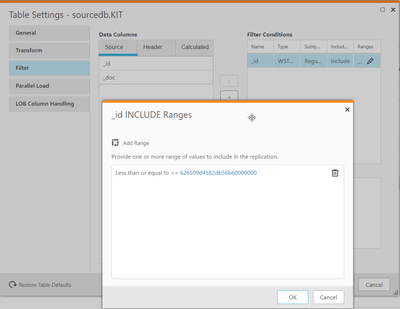
How to filter records by unique identifier "_id" in MongoDB source?
In MongoDB each document has a unique identifier field named "_id", it's generated automatically (by default). Replicate will replicate this field to target side. The field can be used to filter records.
By default the "_id" field was composed by 12 bytes. Below sample shows how to use the first 4 bytes to filter records.
position
detailed explanation
626509d4582db56b600232fb
4 bytes
Representing the seconds since the Unix epoch
5 bytes
random value
3 bytes
counter, starting with a random value
The 4 bytes are Hexadecimal value of Unix epoch seconds, it can be converted to meaningful time by the page:
Excuse me for the delay, I just missed your update.
IN short I have not a better way at present.
In SQLite it's easy to get the current date Julianday value eg
strftime('%s', 'now')
the output is decimal values like 1652842269 (means May 17 2022) however it's hard to transfer it to Hexadecimal value in SQLite to compare with _id value eg 626509d4 (Apr 24 2022).
I will research it further. If I get any progress I will let you know.